Saturday, July 21, 2012

Fun with Flotation with Dr. PG!!

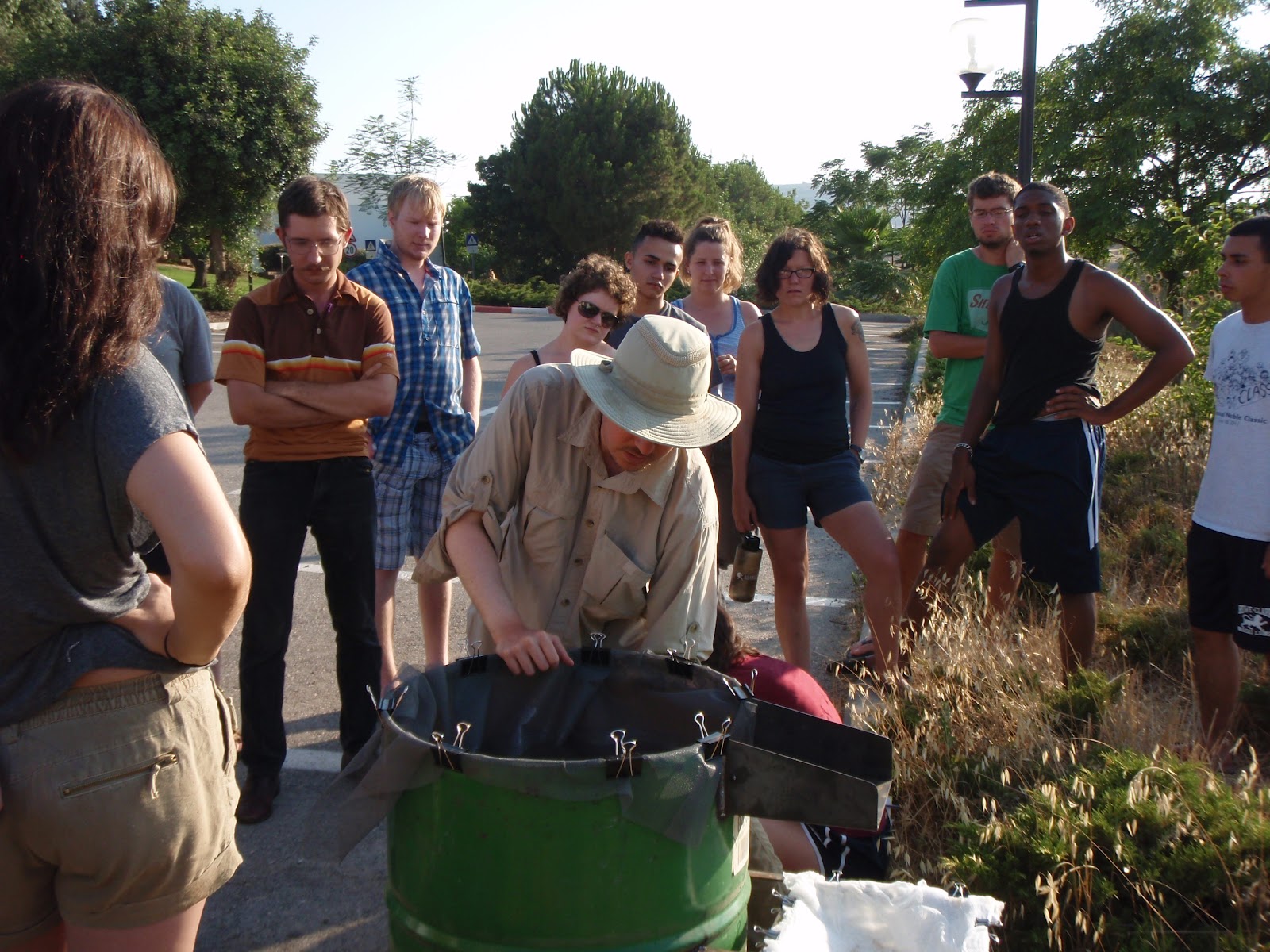
Dr. PG demonstrates flotation

This year at Marj Rabba we are very lucky to have an archaeobotanist (someone who studies seeds and other plant remains from archaeological sites in order to understand the relationships between plants and people in past cultures) working with us (Dr. PG is also acting as an area supervisor, no down time for him). A recent graduate of the Old World Prehistory program at UCONN (http://www.anth.uconn.edu/faculty/munro/graduateprogramOWA.htm), Dr. PG is taking the project to new heights with insights into the plant remains at MR. After some trips to Sahknin, some photos, some pantomime, and some luck, we now have a state of the art flotation system.
Flotation in action
We hope to take soil samples from each of our discrete loci and then float the samples, collecting the heavy and light fractions (the stuff we skim off of the top and the stuff that sinks to the bottom) for analysis. Dr. PG brought his handy-dandy traveling microscope and he'll be looking through the flot (seeds etc... that rise to the top and get caught in the cheesecloth) for evidence of what was growing in the region, what was domesticated, what was wild, perhaps helping us interpret the various areas and structures at the site.
Dr. PG sets up the flotation machine


Last week Dr. PG gave us a hands on tutorial where everyone played with dirt and water.

Dr. PG with the flot in cheesecloth

 Thanks very much to Dr. PG for bringing more science into our lives!

Sunday, July 15, 2012

Up in the Sky

Here is a photo of our celestial companions who have been following us on our drive to the excavation site these past few days.  On Sunday, Jupiter appeard to be sitting in the crescent moon.  We have binoculars powerful enough to see the moons of Jupiter strung out like pearls around the planet.


Thanks to Adler Planetarium in Chicago for the photo.

3d Photogrammetry and Archaeology

One of our projects for the 2012 season is to begin utilizing 3d photogrammetry to record our excavation units and individual features preserved at the site. This is done using exciting new software packages which can build highly accurate 3d models from sets of two dimensional photographs taken with regular digital cameras. Here is one of the first examples of a 3d model of a single feature at the site. This is a stone lined pit that was excavated in 2010 and 2011. To best view the model, click the full screen icon in the top right corner and then click and drag anywhere to move the model around:

Saturday, July 14, 2012

Week One

After our first week of excavating, we are enjoying a day of rest with a gelato run later today.

Everyone arrived without too much difficulty.  We began the week by clearing the effects of the prior winter's rain and cattle intrusion.  We used our new set of tools which we were able to purchase thanks to our wonderful donors.

During the week, we learned what the site was about, why we are digging where we are digging, how to lay out a square (yes excavators you will use algebra), how to start a trench, how to use iPads in the field, and how to wash pottery and lithics.  Here are some photos from our first week.

Tuesday, July 10, 2012

Getting started...

The site as it appeared when we arrived yesterday morning. Lots of the winter growth has now been cut back, and the protective plastic and sandbags were removed preparatory to the real work which will begin tomorrow morning.

Thursday, July 5, 2012


ACH "photo fishing" in Jordan

Pre-Excavation Days in Jerusalem!

What have we been doing to prepare for the excavations:
1. Buy fishing pole. CHECK We left the pole that ACH rigged up for the Jordan project at ACOR, so we had to find a new pole.
2. Buy paper bags. FAIL (that's why AD had to buy some last minute stuff in the US). Paper bags, which we use for animal bones, C14 samples etc..., are a scarce commodity here. Hopefully we now have enough.
3. Buy graph paper. FAIL. No one is carrying A2 paper anywhere in Jordan or Israel, so we will have to modify our daily top plan field records. The key to archaeology is flexibility!
4. Check on Hertz van rental. CHECK/FAIL. One van won't be ready until noon on Sunday, so advance staff teams will pick up the equipment at the IAA, load the vans, and then head north to Ort Braude. Co-director Yo will follow on later in the day.
5. Buy yummy hummus for lunch. CHECK! We visited Abu Hassan on Salah edh Din Street for the best hummus in the city. Today perhaps we will visit Al-Shouleh for schwarma. . .
6. Visit antiquities shops and look for Early Bronze Age pots. SADLY A CHECK. But this is research not directly related to Marj Rabba, I digress.
7. Finish field school syllabus. CHECK. Yo is going over the syllabus for the field school and then we will be good to go.

We are now off to buy various last minute paper supplies for field recording. More adventures later.

Yo "photo fishing" a Neolithic structure at Maitland's Mesa, Jordan

Tuesday, July 3, 2012

E-Day: One Week and counting

Our excavations start one week from today.  Our co-directors have returned from the Jordanian desert and are getting some well deserved rest (after showering and eating something not out of a tin).  Team members are packing and making their way to Israel and some of us are picking up those last minute items that our directors forgot pack. 

We hope you'll follow us as we begin our 4th excavation season at Marj Rabba.